TL;DR: Twenty prompts, four engines, one spreadsheet, about ninety minutes. At the end you will know which buying questions name you, which name a competitor, whether the engines are searching or answering from memory, and which three sources decide most of your answers. That is enough to plan a quarter.
Why run this by hand at all
Because the first thing you need is not a trend, it is a baseline and an understanding of the shape of your problem. Doing it manually once teaches you things a dashboard will never surface — how differently the engines answer, how much the same question varies between asks, and how often the cited sources are pages you have never heard of.
After that, automate it. Doing this weekly by hand is not a good use of anybody's time.
What you need
A spreadsheet, accounts on ChatGPT, Claude, Perplexity and Google (AI Mode or AI Overviews), and ninety minutes. Do it in one sitting if you can, because answers drift over days and you want a coherent snapshot.
The twenty prompts
Replace [category] with how your buyers describe what you sell — not your internal positioning — and [your brand] with your name. Replace [rival] with your closest competitor.
Category and discovery (5)
- What is the best [category] in 2026?
- What are the top [category] options for a small team?
- I need [the outcome your product delivers]. What should I use?
- What is the best free [category]?
- Which [category] is best for [your primary customer type]?
Comparison and alternatives (4)
- [your brand] vs [rival] — which is better?
- What are the best alternatives to [rival]?
- Is [your brand] any good?
- What do people say about [your brand]?
Pricing (2)
- How much does [category] cost?
- What is the cheapest [category] that is actually good?
Problem-aware — the ones most people skip (5)
- Why is [the problem your product solves] happening?
- How do I [the job your buyer is trying to do]?
- What is the easiest way to [the outcome]?
- I tried [the common DIY approach] and it did not work. What now?
- Is [category] worth paying for, or can I do it myself?
Objection and risk (4)
- What are the problems with [category]?
- Is [category] a scam?
- What should I watch out for when buying [category]?
- [category] vs doing it manually — which is better?
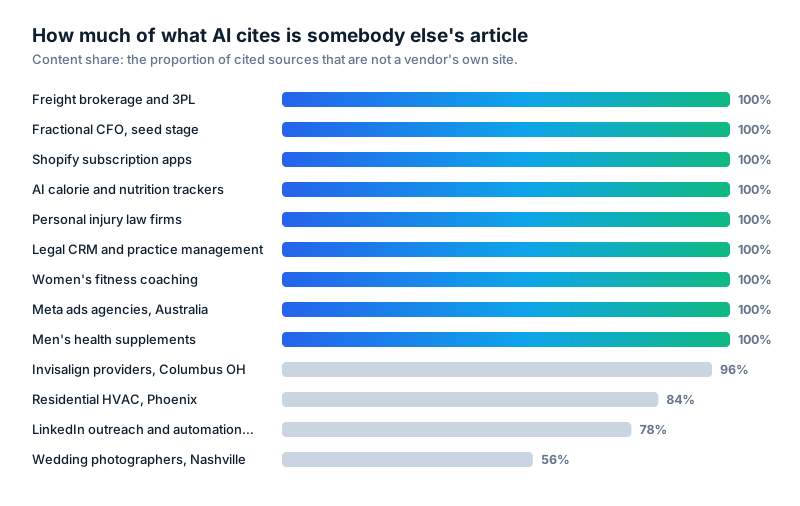
The problem-aware block is the one to pay attention to. Nearly everybody's audit is questions 1 to 11, and in our own measurement those questions produced citation sets made almost entirely of competitors and comparison sites — pages you cannot get a link from. Questions 12 to 16 produce a completely different source list.
What to record
For each prompt, on each engine, six columns:
| Column | What to put in it |
|---|---|
| Named? | Yes / No — were you mentioned at all |
| Position | First, middle, last, or n/a |
| Who else | Every other brand named, in order |
| Cited? | Did the answer show sources — yes means it searched |
| Sources | The domains cited, if any |
| Sentiment | Positive, neutral, negative, or absent |
Eighty rows if you do all four engines. It takes longer than you expect and the fifth column is the one that pays for the whole exercise.
How to read it
Count your presence rate
Named on how many of eighty? Under 20% is normal for a brand that has never worked on this. Over 60% means your problem is position rather than presence.
Find the mode split
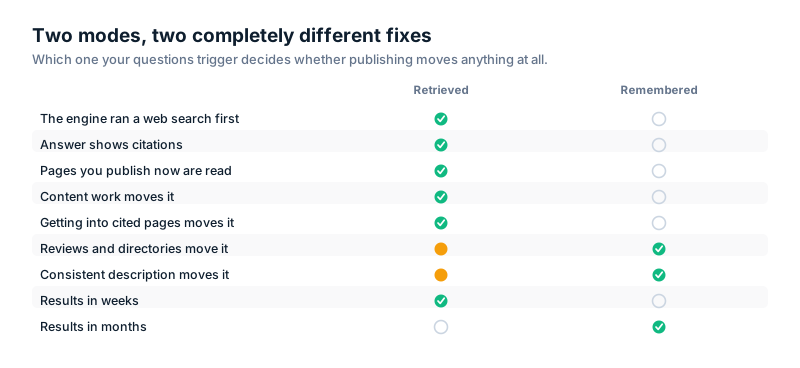
What fraction of answers showed citations? That is your retrieval rate, and it is the number that decides your strategy.
Mostly cited (over 60%). The engines are searching. Content and placement work, and they work in weeks. Go to the next step.
Mostly uncited (under 30%). The engines are answering from memory. Nothing you publish this quarter will be read. Your work is breadth of presence — reviews, directories, consistent description — over months.
Mixed. Split your questions into the two groups and treat them as separate programmes, because they are.
Count the sources
Tally every domain in column five. You will almost certainly find that three to five domains account for most of the citations across all twenty prompts.
That list is the most valuable output of this audit. It is a finite, nameable set of pages that decide your answers, and getting into them is a concrete piece of work rather than a strategy.
Check whether you are in them
Open the top five cited sources and search for your brand name. If you are absent from pages that decide most of your answers, you now know exactly what to do and in what order.
Note who keeps appearing
The brands named across many questions are your real competitive set, which is frequently not the set you track. In our own data, six of the companies the engines kept naming alongside us were not on our competitor list at all.
What the results usually mean
| Pattern | What it means | What to do |
|---|---|---|
| Never named, no citations anywhere | Memory mode, no presence | Reviews, directories, long game |
| Never named, citations present | You are absent from the cited set | Get into those specific pages |
| Named sometimes, always last | Present but weakly associated | Consistency of description |
| Named on problem questions, not category ones | Good content, no commercial presence | Directory and review work |
| Named on category questions, not problem ones | Commercial presence, thin content | Write the explainers |
The honest limitations
One sitting is one snapshot. The same prompt gives different answers on different days, sometimes different modes. This tells you shape, not rate.
Twenty prompts is a sample. A different twenty would move the numbers.
Four engines is not all engines. Add Copilot and Gemini if your buyers use them.
None of that makes the exercise less worth doing. It makes it a starting point rather than a programme.
Automating it afterwards
Once you have done this once, the useful version is the same questions asked weekly across the same engines with the sources recorded automatically, so you can see the rate rather than the snapshot. That is what Peak Answer does, and the free tools cover the technical half without an account.
Frequently asked questions
How long does this take?
Ninety minutes for twenty prompts across four engines, honestly done. Faster if you cut to two engines, and you lose the disagreement between them, which is informative.
How often should I repeat it?
Monthly by hand is sustainable. Weekly needs automation.
Should I use incognito or a logged-out session?
Yes where possible. Personalisation affects answers, and you want the generic result.
What if I am named everywhere already?
Then your problem is not presence and this audit has saved you a quarter of unnecessary work. Move to position and sentiment.
Can I use these prompts for a competitor?
Yes, and it is a quick way to see what their visibility actually looks like rather than what their marketing claims.