TL;DR: We measured our own category the way we measure customers'. Across 505 tracking runs on 22 buying questions, the engines named a predictable cluster of vendors and cited a much less predictable set of sources — and the single biggest driver of competitor citations turned out to be a question type we were asking ourselves.
What we measured
Twenty-two buying questions about AI visibility and AI SEO software, asked across six engines, weekly, with every cited source recorded. 505 runs in the window analysed. The same engine we run for customers, pointed at ourselves.
Measured September 2026. Everything here will drift.
The most-cited domains
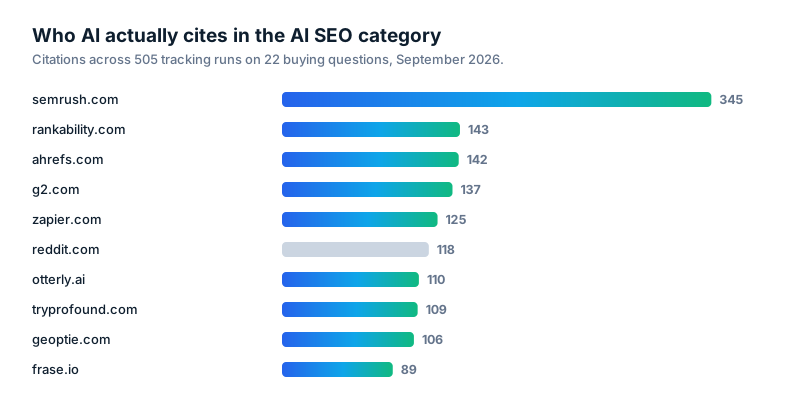
| Domain | Citations | Mostly driven by |
|---|---|---|
| semrush.com | 345 | use case, pricing, category questions |
| rankability.com | 143 | alternatives questions |
| ahrefs.com | 142 | pricing questions |
| g2.com | 137 | alternatives questions |
| zapier.com | 125 | alternatives, category |
| reddit.com | 118 | alternatives questions |
| otterly.ai | 110 | alternatives questions |
| tryprofound.com | 109 | alternatives, comparison |
| geoptie.com | 106 | alternatives questions |
| frase.io | 89 | alternatives questions |
| peec.ai | 87 | alternatives, comparison |
| cituna.com | 83 | alternatives questions |
569 distinct domains were cited in total, so the head is concentrated and the tail is very long.
Three findings
1. The big SEO incumbents dominate, and not for the reason you would guess
Semrush at 345 citations is nearly two and a half times the next domain. But look at what drove it: use case, pricing and category questions — not comparison. The engines reach for established SEO publishers when answering general questions about the category, and reach for specialist sites only when the question names a specific vendor.
The practical implication for anybody in this market: general category questions are answered out of the large established publications, and you will not displace them. Specific questions are where a smaller brand can appear.
2. One question type produced almost all the competitor citations
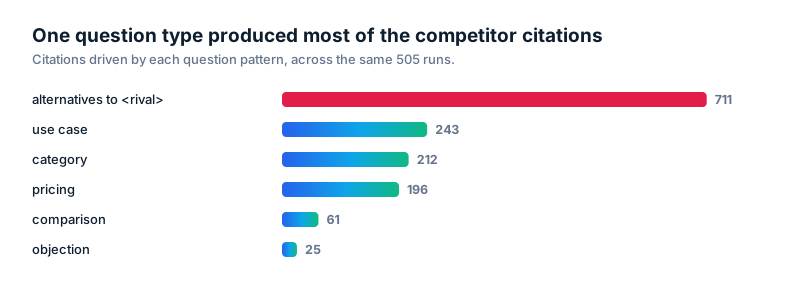
Six of our twenty-two questions were "alternatives to [competitor]". Those six produced the citation counts that put rankability (83), geoptie (95), cituna (72), aiclicks (68), promptwatch (67), llmpulse (66), babylovegrowth (50) and getmint (49) into the top twenty.
That is exactly what you would expect on reflection and we had not reflected on it. Asking an engine to list a competitor's alternatives is asking it to enumerate the competitive set, so the answer is competitors and the sources are competitor comparison pages — none of which is a site you can get a link from.
We have since cut that question type from six to two. The signal was worth having once; it was not worth a quarter of the measurement budget every week.
3. Reddit is a top-ten source in this category
118 citations, almost all from alternatives questions. The engines read threads where people compare tools, and those threads are reachable in a way that Semrush's domain is not.
This is the most actionable finding on the page for a small brand. You cannot become Semrush. You can answer a question in a thread.
What the engines are actually naming
The brand clusters the engines name, in rough order of frequency across our question set: Profound, Peec AI, Otterly, AthenaHQ, Semrush AI Visibility, Writesonic, Scrunch AI, and a long tail of newer entrants that appear on one or two questions each.
The tail is the interesting part. In a category this young, a brand appearing on two questions out of twenty-two is not far from a brand appearing on five, and the distance is a handful of citations rather than years of authority.
What this means if you sell in this category
General category questions are closed. "Best AI SEO software" is answered out of Semrush, Ahrefs and the large comparison sites. Competing there directly is a multi-year project.
Specific and problem-aware questions are open. The tail of 569 domains is where smaller sites appear, and they appear on narrower questions.
Forum threads are a real route. Reddit at 118 citations is a top-ten source and it is the only one on this list that a two-person company can get into this month.
Check what your own question set is measuring. Ours was entirely vendor-selection, which meant our citation data could only ever contain vendors. That is a measurement design problem, not a market fact, and it took aggregating 505 runs to see it.
Method and limits
Twenty-two questions, six engines, weekly, 505 runs in the analysed window, every citation recorded and attributed to the question that produced it. Measured September 2026.
Three honest limits. The question set is ours and a different one would produce different domains. Citation counts are not weighted by answer prominence — a domain cited in passing counts the same as one the answer is built on. And this is one category; the fourteen markets we measured separately differ from each other far more than we expected, so do not generalise these numbers to yours.
Frequently asked questions
Can I see this for my own category?
That is what the product does. The method here is the method it runs weekly.
Why six engines?
Because they disagree. Measuring one tells you about one.
How often do these numbers change?
Enough that we date them. Engines change retrieval behaviour without announcing it.
Is 505 runs enough?
For the shape, yes. For small differences between adjacent domains, no — treat the top ten as meaningful and the ordering within it as approximate.