AEO tool

Peak Answer, an answer engine optimization tool (AEO tool)

Peak Answer asks the buying questions your customers ask, on ChatGPT, Claude, Perplexity, Gemini, Google AI Overviews and Copilot, every week. It shows you which answers name a competitor, then closes those gaps by publishing the content, getting the placements and fixing the site. Start with the free AI visibility audit and see if it makes sense to add an AEO tool like Peak Answer to your stack.

Updated

Free, no account needed.

What is AEO?

AEO stands for answer engine optimization. It is the process of making changes ("optimizations") to your site so that AI engines are more likely to recommend, mention or cite your brand in its answers.

For a lot of buying questions the answer is now the whole page. Somebody asking ChatGPT which tool to use gets 1 paragraph naming 3 options and citing 4 sources.

AEO goes by other names, like GEO (generative engine optimization) and LLM SEO. These are all basically the same. AEO software, an AEO platform and an answer engine optimization tool are all generally the same too: they help you measure whether the engines recommend you, and tell you what to change.

AEO is also quite similar to traditional SEO, with a spin. Making sure your pages are crawlable is the same work. So is making sure the content matches what people search for (keywords in SEO, questions in AEO). With AEO you also want to be quotable, and you want the pages the engines already trust to quote you. Peak Answer's research on 14 markets looks at how hard that is in each one.
What the tool does

3 steps: measure, find the gaps, close them.

It asks the questions your buyers ask

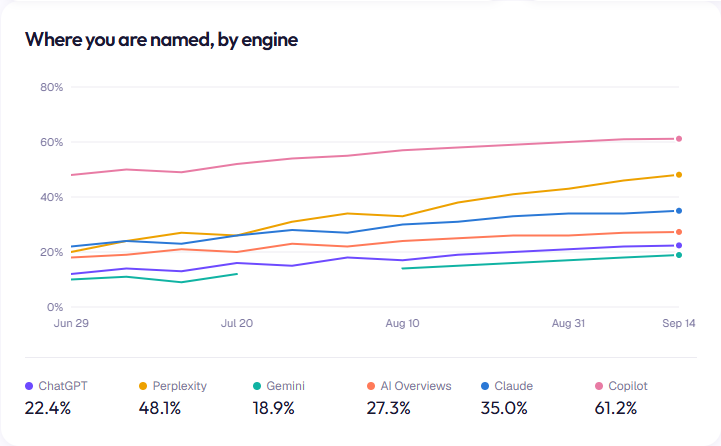
Peak Answer runs your buying questions on ChatGPT, Claude, Perplexity, Gemini, Google AI Overviews and Copilot, every week, and the top ones daily. Each question is run multiple times to improve the sample size.

  • You pick the questions, or Peak Answer generates them from your category
  • Competitors tracked alongside you on every question
  • It also shows you the raw answers and citations that were measured
Peak Answer's per-engine visibility chart in an AEO tool: how often the brand is named on ChatGPT, Perplexity, Gemini, AI Overviews, Claude and Copilot, week by week.
Visibility per engine, week by week.

It shows you which answers name a competitor

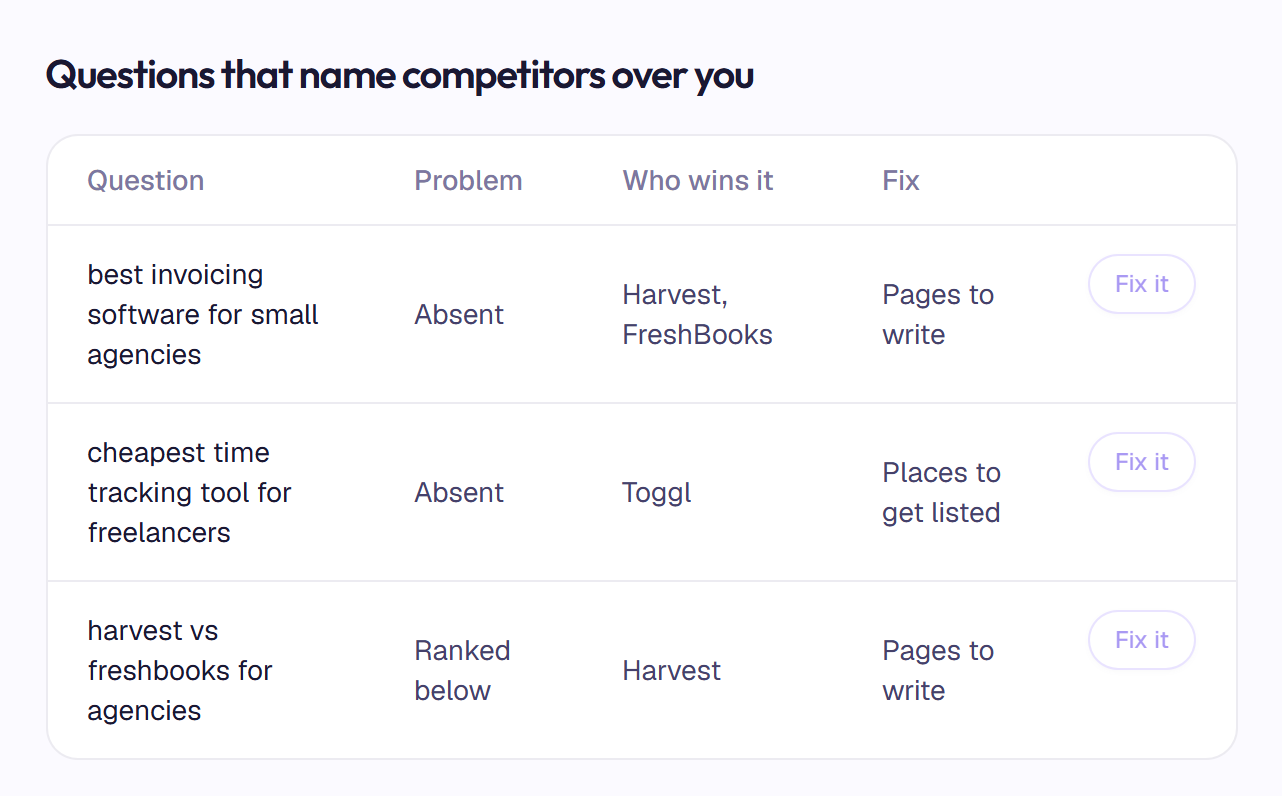
Peak Answer marks every tracked question with who gets named in your place. It also shows why the engines prefer them, which is nearly always a page somebody else wrote about your category.

  • The exact questions you are absent from
  • The competitor named instead, per question and per engine
  • A site health score for the technical faults stopping crawlers reading you
Answer engine optimization gaps in Peak Answer: the questions that name competitors over you, who wins each one, and the recommended fix.
The questions that name a competitor, with who wins each and the fix.

It closes the gaps

Peak Answer writes articles against the questions you are losing and publishes them to your CMS once a person approves them. It also finds the third-party lists the engines already quote and fixes the technical faults.

  • Up to 15 articles a month on the entry plan, published to your CMS
  • 25 directory and list placements, with the outreach written
  • Crawler access, structured data, sitemaps and headings checked continuously
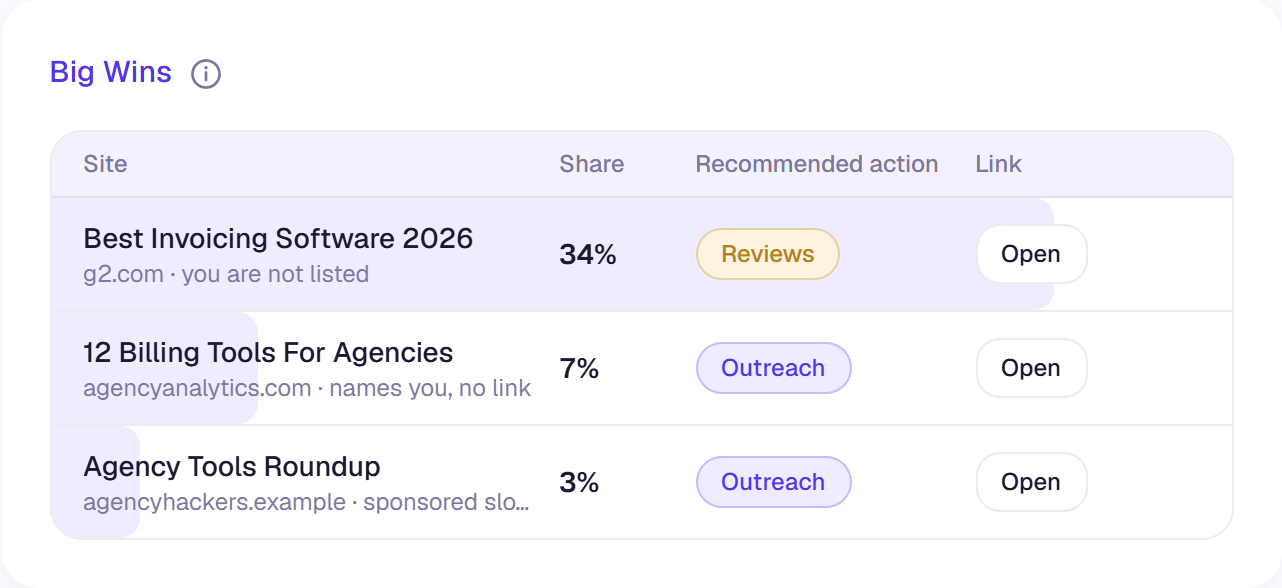
Peak Answer closing an AEO gap: the third-party sites that decide your answers, each with the recommended action.
The sites the engines already quote for your category, with the action for each.

6 engines, on every plan.

  • ChatGPT
  • Claude
  • Perplexity
  • Gemini
  • Google AI Overviews
  • Microsoft Copilot

How to judge an AEO tool

Here's a few factors to consider:

How many engines, and which

6 is a good number right now: ChatGPT, Claude, Perplexity, Gemini, Google AI Overviews and Copilot.

How often it runs, and how many times

Weekly is the minimum. It should also ask the same question more than once per cycle to improve the sample size.

Whether you can see the answer

Check that it stores the raw answer text and the cited URLs.

Whether you choose the questions

Generated question sets are a fine start. The questions that matter most to your business are usually ones only you know to ask.

Whether it does the work

Some tools only report and some do the work, often at a similar price. Look for writing, placements and technical fixes.

What it costs when the trial ends

Check the renewal price as well as the headline. Peak Answer is free for 7 days and then $49 a month. It charges automatically until you cancel. The pricing page states this beside every button.

How Peak Answer does on each:

FactorPeak Answer
Engines6: ChatGPT, Claude, Perplexity, Gemini, Google AI Overviews and Copilot
How often it runsEvery week, with the top questions daily
Repeat runsEach question is run multiple times
Raw answers and citationsSaved and shown
Does the workWrites the content, gets the placements and fixes the site
After the trialFree for 7 days, then $49 a month

FAQs

Answer engine optimization. It is the process of making changes ("optimizations") to your site so that AI engines are more likely to recommend, mention or cite your brand in its answers. You will also see it called GEO (generative engine optimization) and LLM SEO. These are all basically the same.

An AEO tool asks the buying questions your customers ask on the AI engines. It records whether the answer names you or a competitor, and tells you what to change. Peak Answer does that on ChatGPT, Claude, Perplexity, Gemini, Google AI Overviews and Copilot, then writes and publishes the content and gets the placements that close the gaps it found.

It is quite similar, with a spin. SEO competes for a position in a list of 10 results. AEO competes for a mention in 1 paragraph that cites 3 or 4 sources. Being quotable and getting quoted elsewhere matters as much as ranking. The technical groundwork is shared, like making sure crawlers can read your pages.

See our list of the best rated answer engine optimization tools for a detailed breakdown.

The audit at the top of this page is free and needs no card. There are also 36 free tools on the site, including an AI visibility audit, an answer readiness score, a crawler access checker and a prompt set generator. Tracking over time is the paid part.

Technical fixes can land almost immediately. Content and placements take longer. Expect 2 to 3 months for measurable movement.

Plans start at $49 a month for 50 tracked questions, with all 6 engines on every plan. The trial is 7 days and takes a card up front. The first charge lands the day the trial ends and repeats every month until you cancel. Cancel any time from the billing page.

Usually better than for a large one, and it tends to move faster. Run the free audit and the answer for your category takes about 60 seconds.

Not really. It has no white label and no client portal. Users are unlimited and the price is per brand, so you can give a client a login, but anyone running 20 brands should look elsewhere.

Run the free audit

It takes 60 seconds and is free. No card, no install. The audit lists the faults in priority order.

Run the free checkStart a 7 day trial