TL;DR: ChatGPT names brands in two different ways, and each needs a different fix. When it runs a web search, it names whatever the retrieved pages name, so content and third-party placement work, and that can pay off in weeks. When it answers from memory, nothing you publish gets read, and only broad presence over time moves anything. Find out which mode your buyers' questions trigger before you pick a fix.
How ChatGPT picks brands
There is no ranking position to hold. ChatGPT builds an answer from two sources: what the model already knows, and what it retrieves at the moment of asking. Getting named means winning one of those, and they have different rules and different timescales.
Mode one: the model searched
When a question is current, commercial or specific, ChatGPT runs a search first and reads a handful of pages before writing. It often splits one question into several searches, which How ChatGPT finds your page covers. Those pages decide the answer almost entirely. If the retrieved set is a Reddit thread, a G2 category page and two listicles, the brands named in those four pages are the brands in the answer.
This mode can move in weeks, and small companies can win it.
What works here
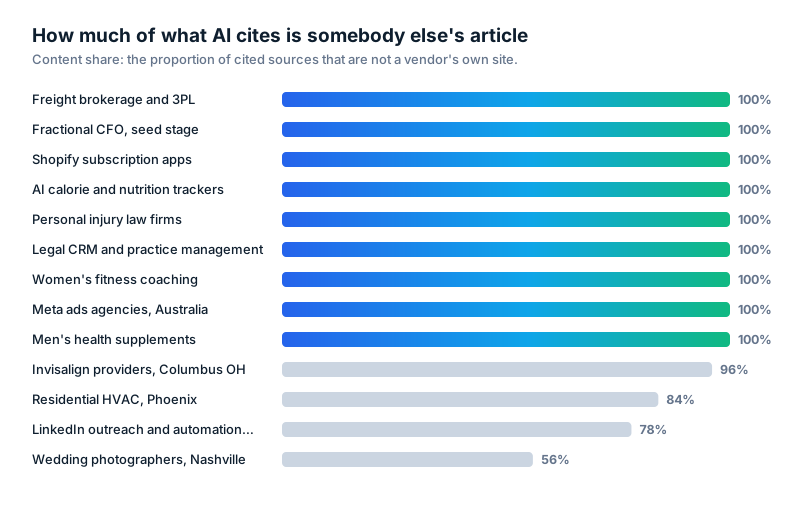
Be in the pages that get retrieved. Those are usually somebody else's pages. Peak Answer measured 14 markets, and in 10 of them at least 80% of cited sources were somebody else's article. Roundups, comparison posts, trade publications and forum threads are the way in. Your product page usually isn't in the running.
Wedding photography is the exception. 73% of cited sources there were articles, and the engines often cite photographers' own portfolios.
Answer the question directly and early. Retrieved pages get skimmed by a model that is extracting claims. A page that states its answer in the first two sentences gets extracted accurately. A page that builds to its answer after six paragraphs of context gets summarized badly or skipped.
Make the specifics extractable. Prices, numbers, dates, named limitations. Models quote specifics and paraphrase vagueness.
Fix what blocks the crawlers. If the engine can't fetch you, nothing else here matters. It's the cheapest work on the list.
What the pages ChatGPT cites look like
Peak Answer looked at 272 pages ChatGPT cited and 318 pages Google cited on specific questions from small provider sites. The ChatGPT pages had a median length of 929 words against 1,780 for Google, and 19% (52 of 272) had a table against 36% (114 of 318). Only 5% (14 of 272) of the ChatGPT pages showed a visible date. ChatGPT cited service or product pages 39% of the time, while 46% of Google's citations were blog posts and guides. The figures are descriptive, and the cited page anatomy study has the method and limits.
Mode two: the model answered from memory
For broad, stable questions the model often doesn't search at all. It answers from what it absorbed in training, which closed months ago. No page you publish this quarter gets read.
This is slower, but it isn't hopeless. What shifts it is breadth of presence across the kind of material that ends up in training data: review platforms, directories, Wikipedia-adjacent reference sites, and sustained coverage in places that get scraped.
What works here
Reviews at volume on the platforms that matter in your category. G2, Capterra, Trustpilot, and whatever the vertical equivalent is.
Directory listings, particularly the small specific ones. They're unglamorous and they're in the corpus.
Being written about repeatedly. This is the slow one, and it compounds.
Consistency of description. If you're described five different ways across the web, the model has no stable fact to learn. One clear sentence about what you do, repeated everywhere, works better than five clever ones.
Finding out which mode you are in
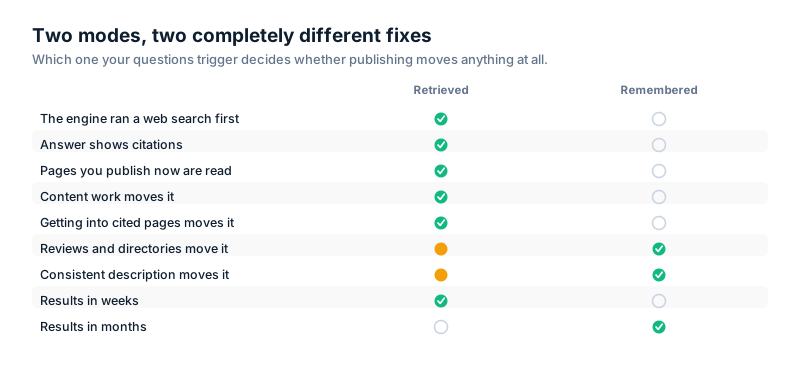
Ask ChatGPT your buyers' question and look for citations. If links appear, it searched. If the answer is confident and unsourced, it answered from memory.
The same question can trigger different modes on different days, so repeat it a few times. Peak Answer records the search-trigger rate per question and buckets it as retrieval, mixed or knowledge, which tells you which of the two lists above applies.
How hard your market is
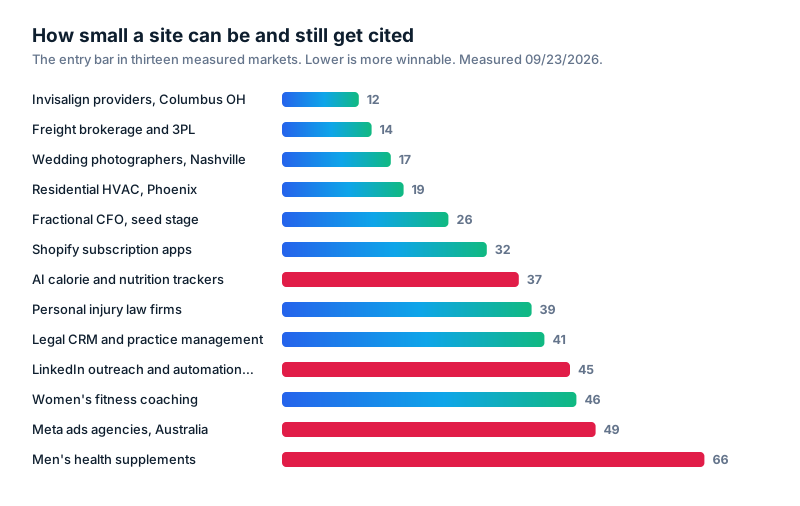
The entry bar is how small a cited site can be and still get quoted. Across the 14 markets Peak Answer measured, it ranged from 15 to 56 out of 100. Some niches you can crack with simple fixes pretty quickly, and others take consistent work over time. The research has the numbers for each market.
What does not work
Keyword stuffing. There's no keyword matching step to exploit.
Schema markup alone. It helps pages get parsed correctly. It isn't a route to being named.
Buying links. The engines cite editorial pages, and a paid link on a site nobody quotes buys nothing. See Does ChatGPT use backlinks?.
Publishing at volume with no target. In markets where most cited sources are somebody else's article, more of your own pages does very little.
Why your site isn't showing up: a 15-minute check
Do these in order. Each one either finds the problem or rules out a cause.
robots.txt, by crawler name (2 minutes)
Open yoursite.com/robots.txt and look for these by name:
| Crawler | Who it belongs to | What blocking it costs you |
|---|---|---|
| GPTBot | OpenAI, training crawler | Use of your pages for training OpenAI models |
| OAI-SearchBot | OpenAI, search | Showing up in ChatGPT search |
| ChatGPT-User | OpenAI, on-demand fetch | Links a user asks it to open |
| ClaudeBot | Anthropic | Claude |
| PerplexityBot | Perplexity | Perplexity |
| Google-Extended | Google, a robots.txt token | Gemini training. It does not control AI Overviews |
| Bingbot | Microsoft | Bing |
A User-agent: * with Disallow: / blocks all of them. A rule that names Googlebot doesn't cover any of them. If you see one of these under a Disallow, you've found your answer, and the fix is a one-line edit.
Blocking is rare. In the LLM SEO crawler data, 2.9% of 818 cited domains blocked GPTBot. It takes two minutes to rule out, and you can run the AI crawler checker to do it for you.
Fetch a page the way a crawler does (5 minutes)
Many crawlers don't run JavaScript, or run it inconsistently. If your pages are built client-side, they may see an empty shell.
Disable JavaScript in your browser, reload your most important page, and read what's there. If the content is gone, that's the problem, and it's a development job. Google says meta descriptions are not a ranking factor but they can shape the snippet shown, so it's worth running the page through the meta description checker while you're there.
Ask the question and look for citations (5 minutes)
Open ChatGPT, ask the question your buyer would ask, and look for sources.
Citations present means it searched. The retrieved pages decided the answer, and there is work you can do that pays in weeks.
No citations means it answered from memory. Nothing you publish now is being read, and the work is slower.
Ask three times across different days before you decide. The same question switches modes.
Open the cited sources and search for your name (3 minutes)
If citations were present, open each cited page and search it for your brand name.
Being absent from the pages that decide your answers is the most common finding here, and the most fixable, since the target is a short list of specific pages. Why AI recommends your competitor covers how to get into them.
A realistic order of work
- Measure first. Which questions, which engines, which mode, who gets named instead of you. How to track your brand in ChatGPT walks through it.
- Clear the technical blockers. Days of work.
- Fix the retrieval-mode questions. Content aimed at specific lost questions, and placement in the pages that already get cited for them.
- Start the slow work in parallel. Reviews, directories, consistent description.
- Re-measure and keep what moved.
FAQs
Getting named in ChatGPT takes weeks for retrieval-mode questions, sometimes less if the gap is a page nobody wrote. For memory-mode questions, months. It depends on your market, and entry bars ranged from 15 to 56 across 14 markets.
ChatGPT doesn't use backlinks as a ranking signal the way search engines do. It uses retrieved pages, and links influence which pages exist and get found. The effect is real and indirect.
You can't pay to appear in ChatGPT's organic answer. Advertising products exist and are separate from what's covered here.
Your own website matters a lot in some markets. Wedding photography is one, where the engines often cite photographers' own sites. In 10 of 14 markets, at least 80% of cited sources were somebody else's article, and there your own pages are a small share of what gets cited.
Claude, Perplexity and Gemini follow the same two-mode structure. The weighting differs: Perplexity searches almost always, and Claude and Gemini vary by question.