What Is Generative Engine Optimization (GEO)?
John, founder of Peak Answer · 20 min read
Updated
Generative engine optimization (GEO) is the process of studying and optimizing for getting your brand named, and your pages cited, in answers from AI engines like ChatGPT, Claude, etc.
It's like SEO, but SEO (search engine optimization) is about optimizing for ranking in search engines like Google, so the goal is to "rank" for keywords. This means that your goal when a user searches a keyword like "best AI visibility tool" in Google or Bing, is that it shows your page at or near the top of the "SERP" (search engine result page).
GEO is similar, but for AI engines. Here your goal is when a user asks the AI chatbot or agent a question, your site is cited, mentioned or even recommended in the answer.
In other words, the goal of GEO is getting mentioned and eventually recommended by AI.
Other names that have slightly different origins but mean the same basic things as GEO include AEO (answer engine optimization), AI SEO and LLM SEO. The answer engine optimization guide covers the same work as we'll discuss here under the AEO name.
GEO at a glance
- The term comes from a November 2023 research paper by a team from Princeton, IIT Delhi and two independent researchers. Its best methods raised a page's visibility in AI answers by up to about 40%.
- Different AI engines cite different sites. In Peak Answer's study of 198 questions in 30 niches, 13.5% of the domains ChatGPT cited also appeared in Google's organic results for the same question, on average.
- Results vary significantly by the type and specificity of question. On specific questions, 60.3% of ChatGPT's citations went to small providers' own sites, against 35.6% on general questions.
- Results can even vary when you ask the same question multiple times. Two runs of the same question in ChatGPT shared about 3 in 10 of their cited domains, and 51% of the brands named in a first run came back in the second.
- There are still broad trends that largely hold up. Of 1,138 pages cited by Google AI Overviews for 493 searches about SEO and AI search tools in October 2026, 37% also ranked in the top 10 for that search.
Where the term GEO comes from
The name comes from a paper called "GEO: Generative Engine Optimization", posted to arXiv on 16 November 2023 by Aggarwal, Murahari, et al. They built a benchmark called GEO-bench, with 10,000 queries, and tested how small edits to a web page changed how much of it showed up in an AI engine's answer.
They tested nine kinds of edits, including adding statistics, adding quotations, citing sources, making the text easier to read, and keyword stuffing. Adding statistics and adding quotations did best, and the best methods improved visibility by up to about 40% over the unedited page. Keyword stuffing scored 17.7 against the unedited page's 19.3. How well each edit worked also varied by niche and topic.
Other names for GEO
You'll see several names used for the same discipline:
- AEO (answer engine optimization), the name Peak Answer uses.
- AI SEO, which also gets used for using AI tools to do SEO work. What is AI SEO covers both meanings.
- LLM SEO and LLMO (large language model optimization). The LLM SEO guide covers that name.
- AI search optimization, common in agency service names.
In practice, there are small nuances but the names are mostly interchangeable. AEO vs GEO vs SEO lays out the specific differences between usage of each term.
How generative engines choose what to cite
AI engines answer questions in two ways. For a lot of questions, generally ones about products, prices or anything recent/changing frequently (like "best AI visibility tool"), they run a web search first, read some of the pages that come back, and write an answer that cites a few of them. In the context of GEO and LLMs, this web search is commonly called "retrieval". For other questions, they answer from what the model learned during training, usually without searching and often without citing anything, or in other words "from memory".
GEO is mostly about optimizing for the first one: when the models search the web. Getting into a model's training data only happens when the model gets retrained, which you can't control and is not that frequent anyway (maybe once a quarter on average), but you can get your pages into the search results the engines retrieve and read today.
When an engine searches, it usually doesn't search your exact question. It turns it into one or more shorter searches first, called "fan-out" queries.
So a question like "what's the best AI visibility tool for a small agency" might become searches like "AI visibility tools for agencies" and "AI visibility tool pricing". The engine then reads a handful of the results and builds its answer from them.
Usually the engine will also list its sources or references at the end or inline with the answer. This is not exactly the same as the fan-out queries used to generate the answer, but it's a close approximation.
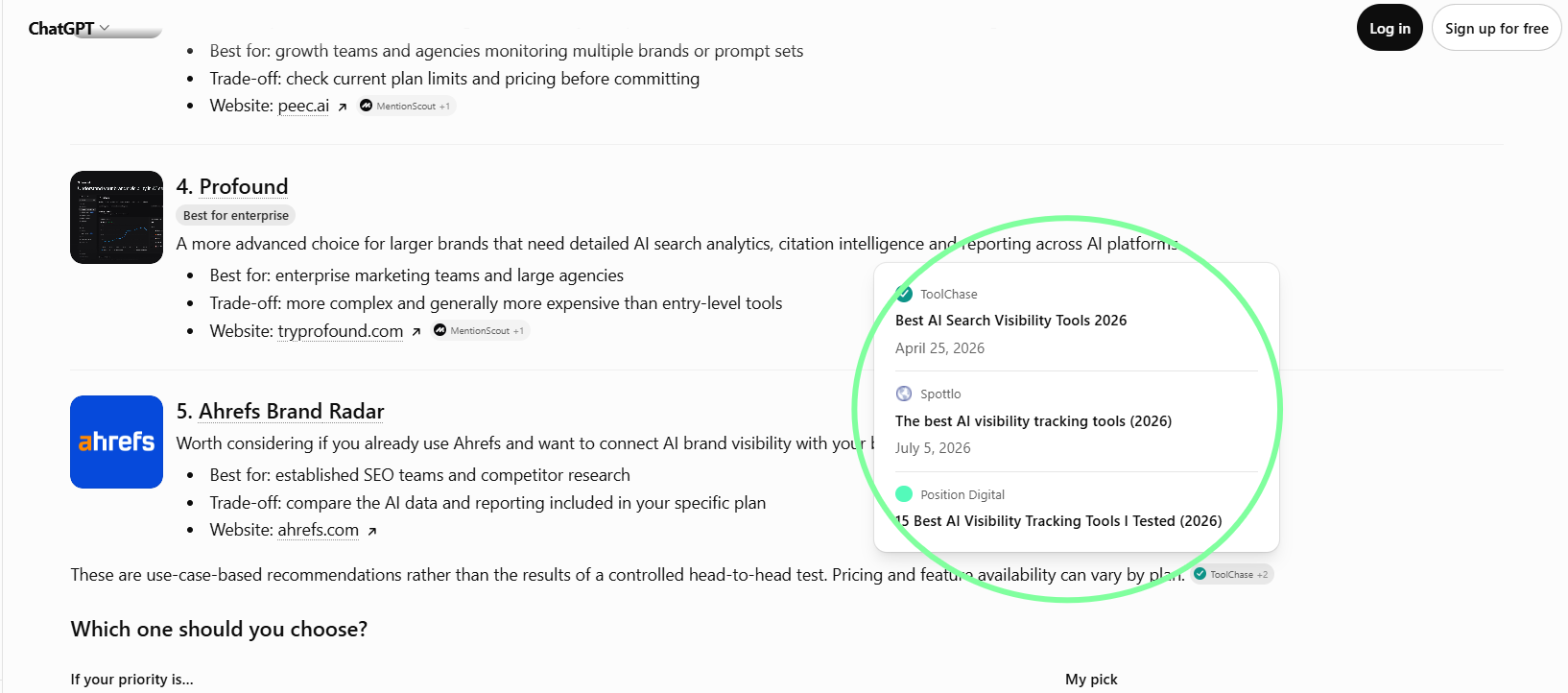
In Peak Answer's ChatGPT data from studies, an answer cited about 6 pages on average. Some question types will cite more sources, others less.
Where those search results come from depends on the engine:
- ChatGPT uses OpenAI's own crawler (OAI-SearchBot), and OpenAI says it sometimes works with other search providers. Its help page links Microsoft's and Shopify's privacy policies for those searches, and Microsoft runs Bing.
- Google AI Overviews and AI Mode use Google's search index, and Gemini can ground its answers in Google Search too.
- Copilot uses Microsoft's Bing.
- Perplexity runs its own web search for most answers.
- Claude can search the web when a question needs it, using Anthropic's Claude-SearchBot.
In other words, the first thing to check for any page is whether it's in the index each engine reads. If Bing hasn't indexed a page, Copilot generally can't find it, and ChatGPT may not either.
GEO vs SEO
GEO and SEO share the same basic foundations. In both cases your pages need to be crawlable and indexed, they need to match what people are looking for (keywords in SEO -> questions in GEO), and your reputation on other sites still matters (backlinks in SEO -> mentions in GEO). SEO is about moving up higher in ranked positions in a list of links, and GEO is about getting a mention inside a written answer.
| SEO | GEO | |
|---|---|---|
| Goal | Rank a page near the top of the results | Get mentioned, cited or recommended in the answer |
| Where you show up | A list of links | A written answer with a few citations |
| What you target | Keywords | Questions, often longer and more specific |
| What earns the spot | Relevance, backlinks and page quality | Relevance, a clear answer, plain facts, and mentions on pages the engine already reads |
| Main measure | Position and clicks | Mention rate and citation rate |
| Change frequency | Positions change gradually | Answers can change every time you ask |
| Where to measure | Search Console and rank trackers | Repeated checks of real questions on each engine, or in tools like Peak Answer |
The two can also reward different sites. In Peak Answer's study of 198 questions across 30 niches, only 13.5% of the domains ChatGPT cited also showed up in Google's organic results for the same question, on average, and ChatGPT cited just 6.8% of Google's top results. Google's own AI Overviews stick closer to Google's rankings: in a separate sample from October 2026, 37% of the pages AI Overviews cited also ranked in the top 10 for that search. So ranking well on Google generally helps a lot more with Google's AI Overviews than it does with ChatGPT. GEO vs SEO goes into more detail on the comparison.
An important distinction: sentiment
Another interesting and notable difference between GEO and SEO is sentiment.
In SEO, everything about what Google's algorithm knows about your page is "baked in" to your ranking position. Meaning if Google ranks you as #1 for a keyword, that means their algorithm already regards your page as the best content to answer that keyword. There is no other context or recommendation provided to the user other than what position your link sits at on the page; all they see is a blue link and some preview text.
LLMs are different. They give more context back to the user, they are conversational. So in some instances they can mention your site, but not in a positive light or in a way that you'd prefer your customers know you as.
For example, ChatGPT might mention you in the answer in a list with 4 other competitors, but say for example that your product or service has "mixed reviews" or is missing key features that the others have.
So beyond just mentions, sentiment is another important factor to track in GEO that doesn't show up at all in SEO.
How to do generative engine optimization
Most of the work for GEO falls into five key areas:
1. Measurement and Tracking: Know where you stand and what to do about it
Before changing anything, you need to know where you stand. Write down the questions your buyers actually ask AI engines (sales calls, support emails and your Search Console queries are good places to find them), run them through the engines, and record what comes back: whether your brand is mentioned, whether your pages are cited, how you're described, and who shows up instead.
That last part is what tells you what to do about it. If a competitor keeps getting recommended on a question, look at the pages the engine cited for that answer. Maybe it's a roundup article you're not in, a Reddit thread where someone recommended them, or the competitor's own page that simply answers the question better than yours. Each of those points to a different fix, which the next four areas cover.
Since answers change from one run to the next (more on that in How to measure GEO below), run each question more than once and check back every few weeks, instead of judging from a single answer. You can do this by hand for a handful of questions, or use an AI visibility tracker like Peak Answer, which runs your buying questions on 6 engines and records the mentions, citations and cited pages each time. If you just want a quick first look, the free AI visibility checker asks ChatGPT 5 buying questions about your category.
2. Technical: Make sure AI crawlers, Google and Bing can reach your pages
Each AI engine has its own crawler (a bot that reads web pages), and if your robots.txt file blocks it, your pages generally can't show up in that engine's answers. The main ones to allow are OAI-SearchBot for ChatGPT search, PerplexityBot for Perplexity, Claude-SearchBot and Claude-User for Claude, and Googlebot and Bingbot for Google and Bing. OpenAI says sites that block OAI-SearchBot won't be shown in ChatGPT search answers.
One small gotcha to be aware of: GPTBot is a different OpenAI crawler, used to collect training data. You can block GPTBot and still show up in ChatGPT search, as long as OAI-SearchBot is allowed. In Peak Answer's crawler access study of sites cited for tech questions, 2.9% of domains blocked GPTBot and 1.5% blocked OAI-SearchBot.
Then make sure the engines can actually read your pages once they get there. Submit your sitemap in Bing Webmaster Tools and Google Search Console, turn on IndexNow for Bing if your platform supports it, and check that your main content shows up without JavaScript. In the same study, 5.6% of the cited pages that loaded were near-empty without it. The free AI crawler checker tests the robots.txt part in a few seconds.
In general, technical fixes are the easiest to implement and give the lowest payoff. Think of it more as opening up the possibility that AI will mention your site, but it won't do much in terms of actually getting you mentioned.
3. Content: Make sure your pages are relevant, specific and accurate
Content is a deep topic and has several important tactics within it:
Answer the question directly in the first two sentences
AI engines build answers from passages that answer the question directly, and the first lines under a heading are the easiest to pull out. So put the answer first, in a sentence or two that makes sense on its own, and then explain the details. For example, a pricing page that opens with "Plans start at $49 a month, with a 7-day free trial" is much easier to quote than one that opens with a paragraph about the company's mission.
It also helps to write each section so it stands on its own. A passage that starts with "as mentioned above", or says "it" without naming the product, loses its meaning when an engine quotes it by itself. Put the product name, the number and the date right in the sentence.
Write pages that answer specific questions really well
Smaller brands with less authority (see Reputation below) generally get cited more on specific questions. In Peak Answer's question specificity study, the share of ChatGPT citations that went to small providers' own sites rose from 35.6% on general questions to 60.3% on specific ones. Google's organic results showed the same pattern, going from 30.5% to 49.9%.
A general question looks like "best bookkeeper", and a specific one looks like "bookkeeper for a construction company on QuickBooks". On the general question you're up against big lists and directories and overall just higher reputation sites, but on the specific one a page written for that exact case has a real shot even as a newcomer. So it's worth having a page for each real buying question that needs its own answer (a use case, an industry, a comparison or a pricing question) rather than one broad page that tries to cover everything.
Add facts an AI engine can quote
AI answers are built from facts like prices, plan limits, dates, numbers and names, and so the engines vastly prefer pages that give them something concrete to cite. In the original GEO paper, adding statistics and adding quotations were the two edits that helped the most. In Peak Answer's look at 272 pages ChatGPT cited on specific questions, 30% showed a price in the first 300 words, 40% had an FAQ section or FAQ schema, 19% had a table and 78% had some structured data (JSON-LD, code that describes the page to search engines).
These numbers describe pages that got cited, so they don't prove what causes a citation. But these are also easy to add, and they make the page better for the people reading it too.
4. Reputation: Get mentioned on the pages AI engines already cite
For a lot of buying questions, AI engines cite lists, review sites, forums and directories as well as brand sites. If those pages don't mention you, your own site is your only way into the answer. So find the pages that get cited for your buying questions, and work on getting included: a listing on the review sites, an accurate profile in the directories, a helpful reply in Reddit, Quora or LinkedIn threads, a mention in the "best X" roundup articles.
This is basically the GEO version of building backlinks (backlinks in SEO -> mentions in GEO), but the pages to go after for ChatGPT often aren't necessarily the same ones that rank on Google. An AI visibility tracker that records the cited URLs for each answer shows you which pages to target.
5. Ongoing optimization: Keep updating and improving
GEO is ongoing work. AI answers keep changing, competitors publish new pages, and the pages the engines cite shift over time. In practice it's a loop: rerun your questions, see what moved, and work on the biggest gaps.
Every few weeks, rerun the same set of questions and compare them against your baseline. If a page you rewrote still isn't getting cited, compare it again with the pages that are, and keep adjusting the opening answer, the facts and the structure. If a new question keeps coming up in sales calls or Search Console, add it to your set, and write a page for it if it needs its own answer.
Keep your facts current too. Prices, plan limits, feature lists and "best of" years go stale fast, and engines that search the web read your page as it is today, so if your page has an old price, that old price can end up in the answer. When something changes, update the page and show an updated date. The same goes for other sites that talk about you: a review site with an old price, or a directory with a wrong description, is a page the engine may read when it answers a question about your brand.
Also keep an eye on sentiment. If an engine keeps describing you with an old complaint or a missing feature, fix it on your own pages and on the third-party pages it cites. And when a page starts getting cited, or a roundup listing starts showing up in answers, look at what it has in common with your other wins and do more of it.
What doesn't work
A few common GEO tactics don't really hold up:
- Keyword stuffing. In the GEO paper, cramming the target phrase into a page scored worse than leaving the page alone. This makes sense, since AI engines aren't really looking for keywords anyway.
- Treating llms.txt as a lever. An llms.txt file is a short guide to your site for AI tools, but there's no published evidence it changes which pages AI engines cite. It's quick to write, so it doesn't hurt to have one, but it won't get a page cited on its own.
- "Programmatic SEO". In other words, generating tons of content across hundreds or thousands of pages in bulk. Kind of fits in the same category as keyword stuffing: if the content isn't actually good or relevant to the question, the engines won't pick it up no matter the quantity.
- Fake reviews and paid mentions made to look independent. These put the listings you've actually earned at risk.
- Judging GEO by a single answer. AI answers change a lot from one run to the next, so one check can show a win or a loss that isn't really there.
How to measure GEO
Since AI answers change from one run to the next, one check doesn't tell you much. When Peak Answer asked ChatGPT 185 questions three times each, two runs of the same question only shared about 3 in 10 of their cited domains (0.299 on average), and only 24% of the brands named for a question showed up in all three runs. Across 10 questions, a brand's mention rate had to move about 19 points on a single run, or about 11 points on an average of three runs, before the change was bigger than the normal run-to-run noise.
So the way to measure GEO is to track a set of real buying questions, run each one more than once, and watch the trend over weeks. Track three things:
- Mention rate: how often your brand is named in the answers.
- Citation rate: how often your pages are cited as a source.
- Who's cited instead: which competitors and pages show up when you don't.
The AI answer stability study has the full numbers. Peak Answer's AI visibility tracker runs your buying questions on 6 engines, daily for your top 10 questions and weekly for the rest, and records the cited pages each time. If you just want a quick first look, the free AI visibility checker asks ChatGPT 5 buying questions about your category.
GEO tools
GEO tools generally fall into three groups:
- Trackers that run your questions on AI engines and record mentions and citations over time, like Peak Answer, Profound, Peec AI and Otterly.
- Page checkers that score how easy a page is for an AI engine to quote, like the free AEO checker.
- Access checkers that test robots.txt, llms.txt and rendering, like the AI crawler checker and the llms.txt checker.
The best GEO tools guide compares the trackers on price, engines and how often they refresh, with prices checked in October 2026. For Google's AI Overviews specifically, the free AI Overview checker shows which pages get cited for a search.
A GEO checklist
Here's a simple order to work through:
- Write down 20 to 50 questions your buyers ask AI engines. Sales calls, support emails and your Search Console queries are good places to find them.
- Run them through a tracker, more than once each, to get a baseline. The free AI visibility checker gives you a quick first look.
- Check that your robots.txt allows OAI-SearchBot, PerplexityBot, Claude-SearchBot, Googlebot and Bingbot.
- Submit your sitemap in Bing Webmaster Tools and Google Search Console.
- List the pages that get cited for the questions where a competitor is named and you aren't.
- Rewrite the opening of your key pages so the first two sentences answer the question.
- Add prices, limits and other facts as plain text near the top of your product and pricing pages.
- Build a page for each real buying question that needs its own answer.
- Get listed, or get your details corrected, on the third-party pages from step 5.
- Rerun the same questions after 4 to 8 weeks and compare your mention rate across the whole set.
FAQs
No, GEO builds on SEO. AI engines that search the web read pages from search indexes, so crawlable, indexed and relevant pages are still the starting point. GEO adds the work of getting into the answer itself, and onto the other pages the engines cite.
Yes, basically. GEO and AEO (answer engine optimization) are two names for mostly the same discipline, with slightly different origins. Peak Answer uses AEO, and AEO vs GEO vs SEO covers the small differences in how each term gets used.
Content changes usually take 4 to 8 weeks to show up. Access fixes, like unblocking a crawler, can show within days once the engines recrawl your site, and OpenAI says a robots.txt change takes about 24 hours to reach ChatGPT search. Getting mentioned on other sites generally takes longer.
There's no published evidence that it changes which pages AI engines cite. The llms.txt proposal is written for AI agents, and it was last updated in August 2026. It's quick to write, so it doesn't hurt to have one, but it won't get a page cited on its own. You can test yours with the free llms.txt checker.
Not to start. The groundwork (crawler access, answer-first pages, plain facts and a baseline of your questions) can be done in-house in a few weeks. An agency or a done-for-you service makes sense when nobody on your team has time to write pages and earn mentions every month. Peak Answer's done-for-you plan covers that work.
Peak Answer starts at $49 a month after a 7-day trial, with all 6 engines on every plan. Other tracking tools range from small monthly plans to custom enterprise pricing, and AI visibility tools by price lists current prices for the main ones.