What the AI visibility checker shows
The checker helps you determine: "When a buyer asks ChatGPT about my niche, does it recommend my brand, or only my competitors?"
For each of the five questions the checker asks ChatGPT, you get:
- Whether you were named, and whether the answer just mentioned you or actually recommended you.
- Who was named instead, so you can see which competitors ChatGPT points people to.
- The sources (citations) behind the answer: the pages ChatGPT cited, like review sites, roundup articles, forums or your competitors' own pages.
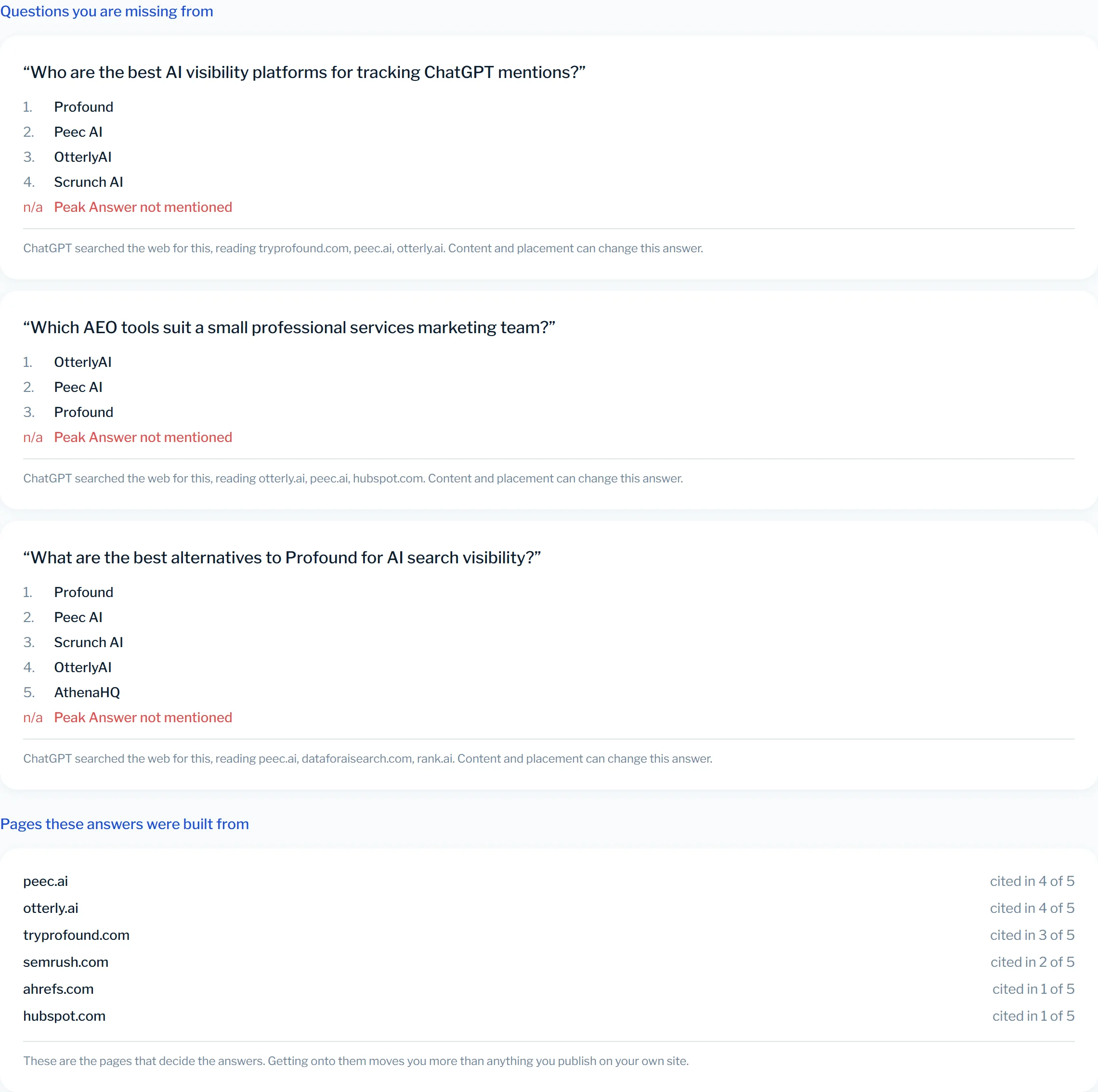
The sources are often the most useful part. If the same roundup article or directory keeps showing up as a citation for the answers you're missing from, getting mentioned or listed on those sites can be one of the fastest ways to improve your AI visibility.
How to read your result
Start with the questions where a competitor was named and you weren't. If it's a comparison question, create a high-quality, honest comparison page to answer the question well. If it's a use-case question, create a service or use case page that gives a detailed how-to on how to tackle it, preferably with specific numbers, facts and test results. And if the same outside source keeps appearing in the answers, think of creative ways to get mentioned or linked by those outside sources.
Generated answers vary, so look for patterns across the questions before deciding anything. Here are some common next steps:
- Fix access problems first. A blocked crawler makes every content improvement harder to discover.
- Pick one commercially important losing question to work on first.
- Study the brands and sources already in that answer.
- Create or improve the page that gives a buyer the clearest evidence for choosing you.
- Run the same question again after the change has been live long enough to be found.
How AI visibility is measured
AI visibility is generally measured as a mention rate: out of a set of buying questions, how often an AI engine names your brand. A single score from one run is a starting point, but it's not very stable.
AI answers change a lot from one run to the next. When Peak Answer asked ChatGPT 185 buying questions three times each, two runs of the same question only shared about 3 in 10 of their cited domains (0.299 on average), and only 51% of the brands named in a first run came back in the second. Across 10 questions, a brand's mention rate had to move about 19 points on a single run, or about 11 points on an average of three runs, before the change was bigger than the normal noise.
So running 5 questions once is merely a first look. It tells you pretty clearly whether ChatGPT knows you at all and who it names in your place. To see whether things are actually improving, you need the same questions run more than once, on a schedule, and on the other engines your buyers use (not just ChatGPT but also Claude, Gemini, etc).
Free checker or weekly tracking
The free checker is a first look using ChatGPT. Peak Answer's paid tracking runs more questions on 6 engines. Your top 10 questions run daily on ChatGPT, Gemini and Google AI Overviews and the rest weekly, and Claude and Perplexity run weekly on a smaller set.
| Free checker | Peak Answer | |
|---|---|---|
| Questions | 5 | 50 |
| Engines | ChatGPT | 6 |
| How often | When you run it | Top questions daily, the rest weekly (Claude and Perplexity weekly) |
| Price | Free | From $49 a month |
Before paying for a tracker, it's worth comparing the main AEO tools and what each one costs per tracked question.
Check the page and for any technical issues
If a competitor is named and you aren't, start with the page that should have won, and check how easy it is for an AI engine to quote.
Then make sure your robots.txt isn't blocking the AI crawlers, and that your site has an llms.txt file that follows the current spec. Usually, the issue is not a technical blocker like this and is more related to either the content itself or your site's authority, but these are easy fixes so always worth checking.