TL;DR: Three things decide it. The engine has to be able to fetch your page, the page has to answer a question somebody actually asked, and it has to answer it in a form that can be extracted. Most sites fail the first, many fail the third, and almost everybody works on the second.
What "cited" actually means
When an AI engine searches before answering, it reads a handful of pages and builds its answer from them, often with links. Being cited means being one of those pages.
It is not the same as being named. You can be named in an answer built from somebody else's article, which is good and is a different mechanism. This page is about being the page.
1. Be fetchable
The engines use named crawlers — GPTBot, ClaudeBot, PerplexityBot, Google-Extended — and a robots.txt written for Googlebot does not cover them. Check each by name.
Then check rendering. If your content only exists after JavaScript executes, many crawlers see an empty page. Server-render anything you want quoted.
This is hours of work and it gates everything else. It is also the most common failure we see.
2. Answer a question somebody asked
Not a keyword. A question, in the words a person would use.
The most reliable source for these is not a keyword tool. It is your Search Console queries, your sales calls, and the first email customers send you. If three customers have asked the same thing in their own words, that is a page.
A page built around "enterprise invoicing solutions" answers nothing. A page titled "how do I invoice for retention on a construction job" answers a question, and a page that answers a question is a page that can be quoted in an answer to it.
3. Make it extractable
This is the part that separates pages that get cited from pages that merely exist.
Answer in the first two sentences. Then support it. A model extracting a claim takes what it finds early.
Use specific numbers, dates and names. Specifics get quoted verbatim. Vagueness gets paraphrased into somebody else's words, which does not help you.
One idea per section, with a heading that says what the section concludes. "Pricing" is a label. "Most teams pay between $40 and $90 a month" is an extractable claim.
Keep the sentences short enough to lift. A model quoting you will take a sentence. If every sentence is forty words with three clauses, there is nothing clean to take.
State limitations. Pages that say what something is not good for get cited disproportionately, because the model is looking for balanced claims.
4. Be in the pages that already get cited
The part most advice skips, and in many markets the only thing that matters.
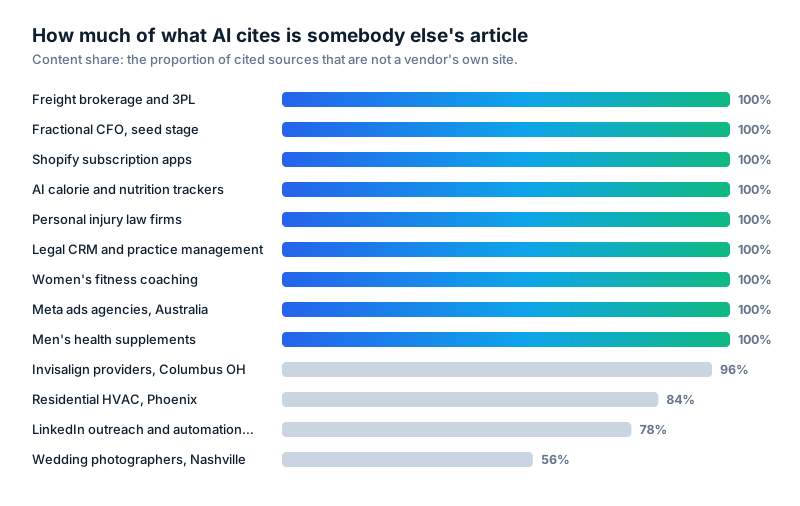
Across fourteen markets we measured, nine had a content share of 100%: every source the engines cited was a third-party article rather than any vendor's own page. In those markets you cannot be cited for your own content, because no vendor is. You can only be named inside the pages that are.
How to find them: ask your question, note the cited domains, repeat across ten questions, and count. Three to five domains usually account for most citations. That is your target list, and it is short.
What to do with it: get mentioned in those specific pages. A correction, a contributed quote, a data point they do not have, a product that genuinely belongs in a roundup they wrote. This is outreach, it is unglamorous, and it is the highest-leverage work available in most markets.
5. Keep it current
Engines favour recently updated pages for anything time-sensitive. A page with a date on it that is eighteen months old loses to one updated last month, other things being equal.
Update genuinely. Changing a date without changing content is a pattern engines are increasingly good at spotting, and it destroys your ability to know what actually changed.
The order to do it in
- Fix crawler access. Hours. Gates everything.
- Find out whether the engines are searching on your questions at all. If not, this whole page is the wrong work and you need the presence playbook instead.
- Identify the cited set for your ten most important questions. An afternoon.
- Get into those pages. Weeks, highest leverage.
- Write the pages nobody has written, aimed at questions you lose. Weeks.
- Re-measure, keep what moved.
What does not work
Keyword density. Schema markup on its own — useful for correct parsing, not a route to citation. Volume publishing with no target, which in most markets is close to the least effective available action. And llms.txt, which no major engine currently honours; it costs ten minutes and is not a strategy.
Frequently asked questions
How long does it take to get cited?
Days to weeks once a page is indexed, if the engine searches on that question and your page is good. Months if it is not searching.
Do I need backlinks?
Not as a direct ranking signal. Links affect whether a page is found and indexed, so the effect is real and indirect.
Does page length matter?
Less than structure. A 600-word page that answers one question clearly beats a 3,000-word page that buries it.
Can I get cited without my own content?
Yes, and in most markets that is the main route: being named inside somebody else's article that the engine cites.