The definition
Answer engine optimization is the practice of increasing the likelihood that an AI system names your brand when it answers a question your buyer asks.
The output is generated, so it varies. You are shifting a rate, not holding a position. Success is a mention, which may or may not carry a link. And the input is a sentence a person typed to a chatbot, not a keyword.
What is AEO in marketing?
In marketing, AEO is the work of getting your brand named when ChatGPT, Perplexity, Google AI Overviews and similar engines answer a question your customers ask. It sits alongside SEO and content in the mix, and you track it by how often you get named across a set of buying questions.
Other names
It goes by other names, like "GEO" (generative engine optimization), AI SEO and LLM SEO. These are all basically the same, and AEO vs GEO vs SEO covers the small differences people draw. The GEO guide covers the same work under the GEO name. AEO software, an AEO platform and an AEO tool are all generally the same too: they help you measure what the engines say about your niche and your brand, and tell you what to change. For a list of them, see best AI visibility tools in 2026.
How it compares with SEO
AEO is quite similar to traditional SEO, with a spin. The core work of making sure your pages are crawlable, making sure the content captures search intent and demand (keywords in SEO -> questions in AEO), and building your external reputation (backlinks in SEO -> mentions in AEO) remains the same. But there are differences and nuances to AEO to the point where having a tool dedicated for it makes a lot of sense. The full side-by-side is in AEO vs SEO.
The two mechanisms
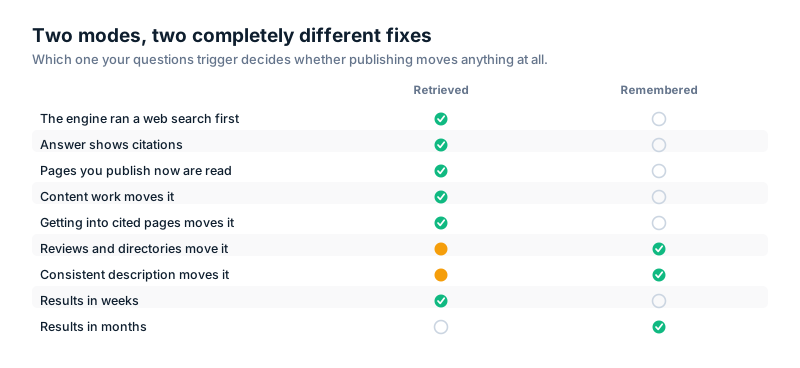
Everything in AEO comes down to which of these a question triggers.
Retrieval. The engine searches, reads pages, and summarizes. The retrieved pages decide the answer. Winnable in weeks, winnable by small companies, and addressed by content and placement.
Memory. The engine answers from training data. Nothing published now is read. Addressed by breadth of presence over months: reviews, directories, consistent coverage.
What actually works
- Technical access. AI crawlers can fetch and parse your pages. Blocking is rare (2.9% of 818 cited domains block GPTBot) but cheap to check. Check that content renders without JavaScript too.
- Answer-first writing. State the answer in the first two sentences, then support it.
- Extractable specifics. Numbers, prices, named limits.
- Being in the cited set. Find the pages the engines cite for your questions, and get named in them.
- Consistency. One sentence describing what you do, the same everywhere.
- Structured data. Helps your pages get parsed correctly.
How AEO is measured
You can't look up a position, so you ask the questions repeatedly and record what comes back. That takes four parts:
- The questions, drawn from what buyers actually ask.
- The engines, several of them, since they disagree.
- Presence, recorded per run: were you named, and who else was.
- The sources, the pages cited in each answer, which tell you what to do next.
How stable are AI answers?
Peak Answer asked ChatGPT 185 questions 3 times each and compared the runs. Two runs of the same question shared about 3 in 10 of their cited domains (a mean overlap of 0.299). Of the brands named in any of the 3 runs, 24.1% were named in all 3 (averaged over the 157 questions that named a brand), and 51% of the brands named in run 1 showed up again in run 2. The AI answer stability study has the method and limits.
The research
Peak Answer measured 14 markets, and the entry bar (how small a cited site can be and still get quoted) ran from 15 to 56 out of 100. The numbers for each market are on the research page.
FAQs
No, AEO isn't replacing SEO. It is a second surface with its own rules. Traditional search still sends most clicks for most businesses, and the technical work overlaps heavily.
A small company can often do AEO more easily than SEO. The engines cite small sites regularly, and how small depends on the market.
You don't need an AEO tool for a single check. Ask the engines yourself. For anything continuous, yes, since the output varies between asks and one answer tells you little about a rate.
Measuring AEO weekly is enough for most businesses. Daily is useful if you publish frequently and want to see effects quickly.
The first thing to do in AEO is check that AI crawlers can read your site. It takes an afternoon, and everything else depends on it.