AI visibility tracker
An AI visibility tracker asks AI engines the questions your customers ask, then records whether each answer names your brand and which pages it cites. It repeats this on a schedule, so you can track mentions and citations over time.
Updated
Start the 7-day trialor check 5 questions free with the AI visibility checker
What an AI visibility tracker measures
An AI visibility tracker measures how often your brand is named in AI answers, which pages those answers cite, and who gets named when you don't. The table lists each measure, how often it's taken, and the size of change that counts as significant or noteworthy.
| Measure | How often | What counts as a significant change |
|---|---|---|
| Brand mention rate across 10 questions, 1 run | Every run | About 19 points (19.3). Based on 98,400 comparisons across 82 brands |
| Brand mention rate across 10 questions, averaged over 3 runs | Every 3 runs | About 11 points (11.2). Based on 98,400 comparisons across 82 brands |
| Answers with at least one cited page | Every answer | 805 of 807 answers (99.8%) had cited pages |
| Brands from run 1 that appear again in run 2 | Every repeat run | 51% (142 questions). The other 49% didn't come back on the same question |
| Brands named in all 3 runs | Every 3 runs | 19.8% (238 of 1,199 brands named in any of the 3 runs) |
| Cited domains shared between 2 runs | Every repeat run | About 3 in 10 (0.299 average overlap, 185 questions) |
Those numbers come from the AI answer stability study, where Peak Answer asked ChatGPT the same buying questions 3 times each. The run-to-run figures (51%, 19.8% and about 3 in 10 cited domains) come from 185 questions and 555 answers. The cited-page count covers all 807 answers, which adds 84 questions that ask for a brand by name. Of the brands named in any of the 3 runs for a question, only 19.8% were named in all 3.
In practice, this means a single check is not that reliable or stable over time. It fluctuates, with sites moving in and out of the mentions and citations from run to run.
That said, there are usually still broad trends that hold true, like certain brands will be repeated consistently from run to run, or the types of pages the engine cites will be of a similar mix from run to run.
How Peak Answer tracks AI visibility
Peak Answer asks your buying questions on 6 engines: ChatGPT, Claude, Perplexity, Gemini and Google AI Overviews. Your top questions (10 on Starter, 25 on Growth and 50 on Pro) run daily on ChatGPT, Gemini and Google AI Overviews, and the rest run weekly. Claude runs weekly on your top 5, 10 or 13 questions and Perplexity on up to 50, 100 or 100 (Starter, Growth, Pro). On paid plans, ChatGPT runs each question 3 times a week to improve the sample size.
You can track 50 questions on Starter, 150 on Growth and 400 on Pro.
For every answer, it saves the raw text, the brands named, and the pages cited, with their URLs. So when your mention rate moves, you can open the actual answers and see what changed: a new competitor showing up, a roundup that dropped you, or a page of yours that started getting cited.
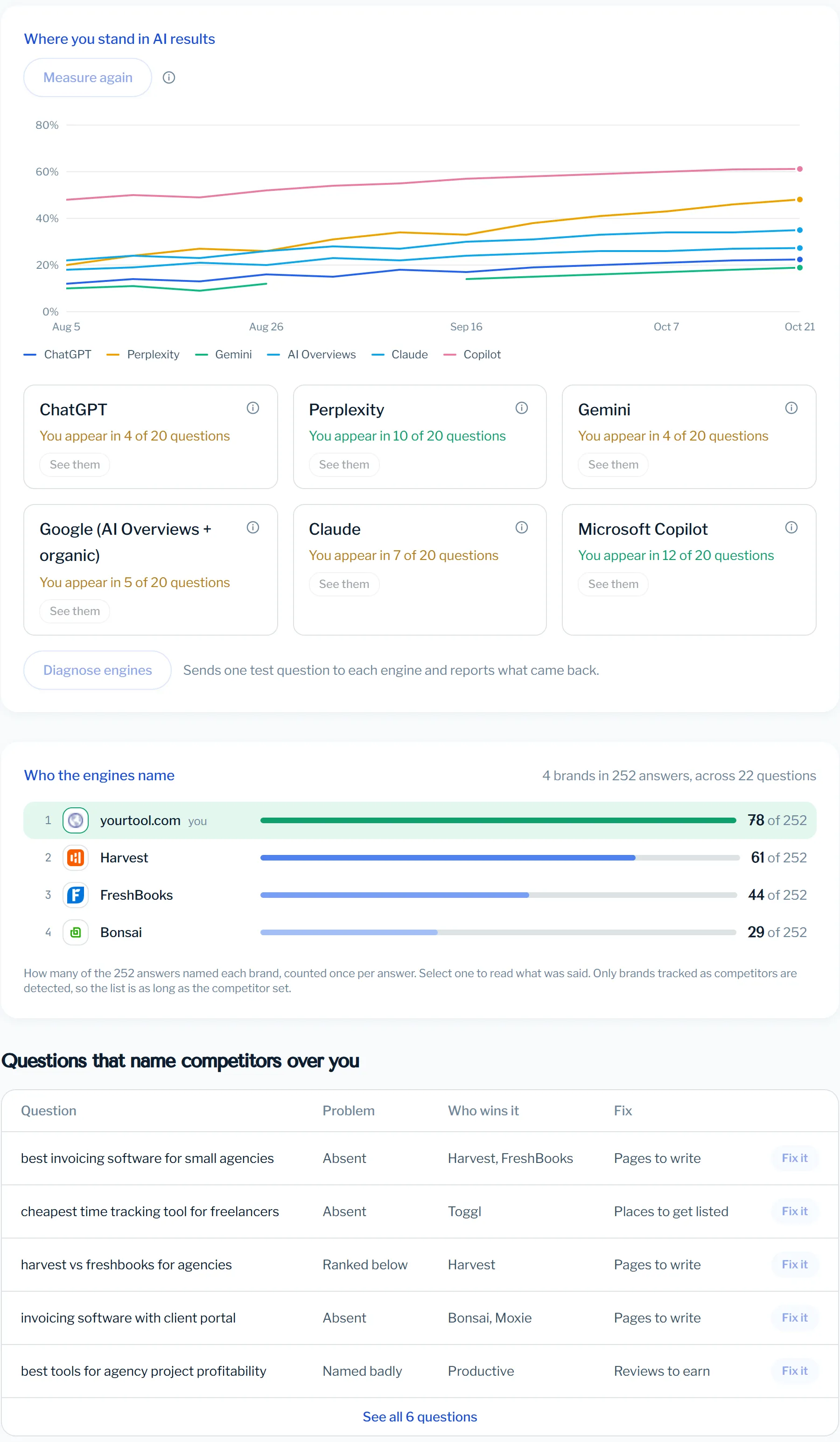
It also tracks the competitors you add, and every answer records the other brands named too. That's usually the most useful part of the data. If a competitor keeps getting named on a question where you're missing, the pages cited in that answer show you where they're getting their visibility from.
What happens after tracking
Peak Answer uses the tracked questions and answers to build your strategy, and turns each lost question into specific actions:
- Content: it writes the article aimed at the question you're losing. Starter includes 15 articles a month, Growth 30 and Pro 60.
- Mentions: it ranks the sites the engines already cite for your category, finds the directories worth listing on, and drafts the outreach for the rest.
- Socials: it finds the Reddit, Quora and LinkedIn threads worth answering, and drafts the replies for you to post.
- Technical: it flags the problems stopping AI crawlers from reading your site, like a blocked crawler or content that only shows up with JavaScript.
It doesn't run backlink exchanges or buy links. If you'd rather do the outreach yourself, earning those links by hand takes a few hours a week.
AI visibility tracking tools compared
Here's how nine AI visibility trackers compare on price, engines, how often they refresh, whether they write content and how many brands they cover. The second table adds three things that matter once the tracking is running: an API or MCP server for your own tools and AI assistants, help earning links and mentions, and whether the tool finds social threads for you to join. Prices and features were checked between 11 October 2026 and 9 November 2026 on each vendor's own site.
| Tool | Plan | Price | Billing | Allowance |
|---|---|---|---|---|
| Peak Answer | Starter | $49/month | Monthly, 7 day trial | 50 prompts, 15 articles a month |
| Peec AI | Starter | $95/month | Monthly | 50 prompts, 3 chosen models, daily tracking, 1 project, 1 country, unlimited users |
| Otterly | Standard | $189/month | Monthly or annual, 15% off annual | 100 search prompts; extra in batches of 100; unlimited workspaces; API (2,000 requests a month) and MCP (2,000 requests); Agent Analytics; Looker Studio connector; 5,000 GEO URL audits a month |
| Profound | Enterprise | Custom (Tailored packages, no dollar amounts) | Custom package | Custom prompts, unlimited opportunities, AI Marketer credits, ChatGPT Shopping, all-time data history, CSV/JSON export, API, SSO/SAML, SOC 2, custom languages and regions |
| AthenaHQ | Starter | $295/month | Monthly or annual, 17% off annual | 3,600 credits per month (1 credit = 1 AI response); $300/month free credit with 1-month rollover; unlimited topics, prompts and competitors; extra credits and API access are paid add-ons |
| Semrush AI Visibility (Toolkit) | Toolkit add-on | $99/month | Monthly per domain | 25 prompts for Prompt Tracking; +50 prompts for $60/month; Semrush One tiers raise to 50/100/200 |
| Rankscale | Pro | $99/month | Monthly or yearly, 15% off yearly | 1,200 credits/month, up to 4,800 answers, 50 page audits |
| AI Peekaboo | Configurable plan | From $30/month | Monthly or annual | Configurable. Default is 1 brand, 40 prompts, 3 AI models, checked every 2 days; up to 150 brands and 500 prompts per brand |
| AIclicks | Starter | $59/month | Monthly or yearly (up to 29% off yearly); 3 day trial | 30 prompts, 4,650 LLM responses a month; 5 AI-optimized articles a month; 1 website, 1 country |
Below you'll find what each tool does once the tracking is running.
| Tool | Engines | Refresh | Writes content | Brands | API or MCP | Help earning links and mentions | Social threads |
|---|---|---|---|---|---|---|---|
| Peak Answer | ChatGPT, Claude, Perplexity, Gemini, Google AI Overviews and Google AI Mode | Weekly, top questions daily (Claude and Perplexity weekly only) | Yes | 1 brand on this plan | API and MCP server on every plan, including the trial | Ranks the sites the engines cite, finds contacts, drafts the outreach, lists directories to submit to | Finds Reddit, Quora and LinkedIn threads and drafts replies |
| Peec AI | Choose 3 of ChatGPT, AI Mode, AI Overviews, Microsoft Copilot, Gemini, Naver AI (Perplexity is an add-on) | Daily | No. The vendor says it does not write content itself | 1 project; unlimited users | MCP on every plan; API from Pro | Lists sources where competitors are cited and you aren't; no outreach | Reports cited Reddit and forum posts only |
| Otterly | ChatGPT, Google AI Overviews, Perplexity, Microsoft Copilot (add-on: Google AI Mode, Gemini, Claude) | Daily | No article writer in the plan (briefs and audits only). A separate free GEO Landing Page Creator tool exists | Unlimited workspaces | API and MCP on Standard and up | Cited-source report and off-page suggestions; no outreach | Reports cited Reddit and social posts only |
| Profound | ChatGPT, Gemini, Google AI Overviews | Daily for 7 days | Yes. Its AI agent is described as one that will research, write, report and collaborate | Unknown. Projects are shared spaces for teammates, and the page doesn't list a brand count | API and MCP on Enterprise | Agents find authors of cited articles and draft outreach | Agents surface Reddit threads to join |
| AthenaHQ | 11 models: ChatGPT, Perplexity, Google AI Overviews, Google AI Mode, Gemini, Claude, Copilot, Grok, DeepSeek, Meta AI, Mistral | Set per prompt, every 1 to 4 weeks or on chosen days of the month. Daily not stated. | Yes. Content Hub writes a brief, then a full article. | Multiple brands through Groups; one country on Starter, multi-region on Enterprise. | MCP server; API on paid plans (add-on on Starter) | Outreach workflow finds the author and drafts a pitch (premium) | Reports cited social posts only |
| Semrush AI Visibility (Toolkit) | ChatGPT, Google AI Mode (full list not stated) | Prompt Tracking daily; Brand Performance weekly | Separate product: Semrush Content Toolkit | Extra domains or locations $99 each | Toolkit data isn't in Semrush's API or MCP | Lists sources that cite competitors; outreach tools are in other Semrush toolkits | Reports cited Reddit and Quora only |
| Rankscale | ChatGPT, Perplexity, Google AI Mode, Google AI Overviews, Gemini, DeepSeek, Mistral, Claude, Microsoft Copilot, Meta Muse Spark, others | Hourly to monthly scheduling | No. It gives content improvement suggestions and does not write content | 10 brand dashboards; extra slots purchasable | MCP (beta) on paid plans; API from Pro+ | Citation gaps plus how-to guides; no outreach | Reports cited Reddit and YouTube only |
| AI Peekaboo | ChatGPT, Gemini, Perplexity, Google AI Overviews, Google AI Mode; Claude API and Microsoft Copilot are add-ons | Configurable: monthly, weekly, every 3 days, every 2 days or daily | No article writer in the app (content briefs only). A separate open source content skill drafts from them | Yes. 1 to 150 brands, each with its own prompts, competitors and dashboard | API and MCP on paid plans | Ranks cited domains to prioritize outreach; no contacts or drafts | Reports cited Reddit and YouTube only |
| AIclicks | Choose 3 of ChatGPT, Gemini, Microsoft Copilot, Google AI Overviews, Google AI Mode, Naver AI, and Claude, Grok, Perplexity, Mistral, Deepseek, Qwen and Meta via API | Daily | Yes. AI-optimized articles. | 1 website on Starter; unlimited on Pro | API and MCP on Pro and Business | Outreach queue of cited pages that leave you out | Drafts comments for threads that show up in citations |
The main differences come down to what you need after the numbers. Peec AI's Starter tracks 50 prompts on 3 models daily, and says it doesn't write content itself. Otterly's entry plan is $29/month for 15 prompts. Profound offers a free trial, and its Enterprise plan is custom priced. AthenaHQ has a free Essential plan with 300 credits, and the Semrush AI Visibility Toolkit is an add-on for teams already on Semrush. Of the smaller tools, Rankscale's cheapest plan, Essentials, starts at $17/month billed yearly, AI Peekaboo prices by the number of checks, and AIclicks Starter is $59/month.
Most of these tools show which sites the AI engines cite, but only a few help you get onto them. Profound's agents and AthenaHQ's outreach workflow find the author of a cited article and draft the pitch, AIclicks builds an outreach queue from cited pages that leave you out, and Peak Answer ranks the cited sites, finds the contacts, drafts the outreach and lists the directories worth getting onto. Peec AI, Otterly, Rankscale and AI Peekaboo list the sources and leave the outreach to you.
Social works the same way. Most tools tell you when a Reddit thread was cited. Peak Answer finds Reddit, Quora and LinkedIn threads worth answering and drafts the replies, AIclicks drafts comments for threads that already show up in citations, and Profound's agents surface Reddit threads to join.
For API and MCP access, Otterly, AI Peekaboo and AIclicks include both on their paid or mid-tier plans, while Profound keeps both on its custom-priced Enterprise plan and Peec AI lists MCP on all plans with its API on Enterprise. The Semrush AI Visibility Toolkit's data isn't in Semrush's API or MCP, which come with other Semrush plans. Peak Answer includes its MCP server on every plan, so you can ask Claude or ChatGPT about your visibility without opening the dashboard.
If you have a content team and only want the tracking, a tracking-only tool may suit you better. If you want to go beyond tracking and run your full SEO and AEO routine from one place, that's what Peak Answer is built for. And if you'd rather weigh more options first, there are 12 AI visibility tools compared side by side, with prices.
How much an AI visibility tracker costs
AI visibility trackers range from free plans to custom enterprise pricing. On the low end, AthenaHQ's Essential plan is Free with limited credits, Rankscale Essentials starts at $17/month billed yearly, and Otterly Lite is $29/month. On the high end, AthenaHQ Starter is $295/month and Profound Enterprise is custom priced.
Peak Answer's Starter plan is $49 a month after a 7-day free trial, with all 6 engines on every plan. Growth is $99 a month and Pro is $199 a month, and annual billing gives a 2 month free discount on all plans.
Is an AEO tracker the same as an AI visibility tracker?
Yes, they're basically the same thing. An AEO tracker (answer engine optimization) and an AI visibility tracker both ask AI engines your customers' questions and record whether your brand is named. You'll also see GEO tracker and LLM tracker. AEO, GEO and LLM SEO are mostly different names for the same job, so the tools overlap too.
FAQs
Tracking AI visibility weekly is enough for most questions. For the questions most critical to your brand, you might want to check daily. AI answers change from one run to the next, so the trend over several weeks tells you a lot more than isolated point measurements.
Yes, an AI visibility tracker can track your competitors. With Peak Answer you can add the competitors you care about, and every answer records their names when they're mentioned, so you can track how often each one gets mentioned.