TL;DR: Usually one of six things, and they are not equally likely. Start with whether ChatGPT can read your site at all — it is the most common cause, takes an afternoon to check, and nothing else works until it is fixed.
First, check it can actually read you
More sites fail here than anywhere else, and it is invisible from your own analytics.
ChatGPT's crawler is called GPTBot. It is not Googlebot. A robots.txt that welcomes Google can block GPTBot entirely, and plenty do — sometimes deliberately, usually because somebody copied a snippet from an article about blocking AI scrapers and forgot.
Check: open yoursite.com/robots.txt and look for GPTBot, OAI-SearchBot and ChatGPT-User by name. Any Disallow: / under those and you have your answer.
Also check: fetch one of your key pages with JavaScript disabled. If the page is blank, the crawler sees a blank page too.
Cost: an afternoon. Nothing else on this list matters until this is done.
Second: it is answering from memory, not searching
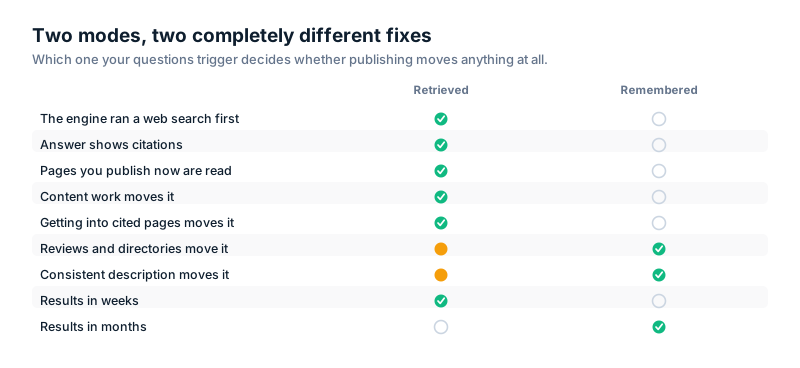
ChatGPT does not always search. For broad, stable questions it answers from what it already learned, and that training data closed months ago.
If it is not searching, no page you publish this week will be read. That is not a failure of your content; it is a question about which nothing you publish can help.
Check: ask your question and look for citations. Links and sources mean it searched. A confident, unsourced answer means it did not. Do this three times on different days, because the same question varies.
Cost to fix: months, and the work is breadth of presence — reviews, directory listings, consistent coverage — rather than publishing.
Third: it searched, and you are not in the pages it found
This is the one people least expect and it is extremely common.
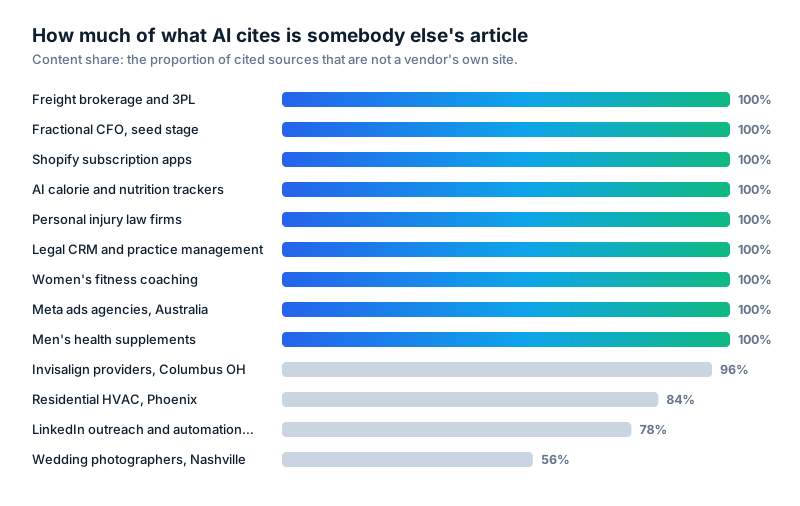
When ChatGPT searches, it reads a handful of pages and names the brands in them. If those pages do not mention you, you are not in the answer — no matter how good your own site is.
We measured fourteen markets and found that in nine of them, every single cited source was somebody else's article rather than any vendor's own site. In those markets your own pages cannot put you in the answer. Only being named in other people's pages can.
Check: ask the question, open the cited sources, and search them for your name.
Cost to fix: weeks to months, and it is outreach rather than publishing.
Fourth: your pages do not answer the question directly
Models extract claims. A page that states its answer in the first two sentences gets extracted accurately. A page that spends six paragraphs establishing context before answering gets summarised badly or skipped.
Check: read your key page's first two sentences. Do they answer the question the page is about? If not, that is a day's editing with real upside.
Cost: days.
Fifth: you are described inconsistently
If your site, your LinkedIn, your G2 profile and three articles describe you four different ways, there is no stable fact to learn and nothing clean to match against.
Check: search your brand name and read the first ten descriptions of what you do. If you cannot summarise them in one sentence, neither can a model.
Cost: days to edit, months to propagate.
Sixth: you are too new, and the honest answer is time
If your site is three months old, has few referring domains and nobody has written about you, the engines have nothing to go on. This is not a fixable error; it is a stage.
What helps: being measured so you know which of the above also applies, and starting the slow work now rather than in six months.
How much time this takes, realistically
| Cause | Time to fix | Time to show |
|---|---|---|
| Crawler blocked | Hours | Days to weeks |
| Pages do not answer directly | Days | Weeks |
| Absent from cited pages | Weeks | Weeks to months |
| Inconsistent description | Days | Months |
| Memory mode, no presence | Months | Months |
| Too new | n/a | Months |
The fastest useful thing you can do today
Check robots.txt for GPTBot. Then ask ChatGPT your single most important buying question and look at whether it cited sources. Those two checks take fifteen minutes and between them narrow six causes to two.
The free audit does the technical half automatically if you would rather not do it by hand.
Frequently asked questions
How long until ChatGPT knows about my site?
For search-mode answers, as soon as your page is indexed and gets retrieved — potentially days. For memory-mode answers, the next training cycle, which is months and not announced.
Does ChatGPT use Google's index?
It uses Bing and its own crawling, so Bing Webmaster Tools is worth more here than people assume.
Will submitting my site to ChatGPT help?
There is no submission form. Being crawlable, being in the pages that get cited, and having consistent presence is the whole mechanism.
My competitor is smaller and they show up. How?
Almost always because they are in the pages ChatGPT cites and you are not. Size is a weak signal; presence in the retrieved set is a strong one.