TL;DR: Find the pages the engines cite for the question you are losing, and check whether your competitor is in them. In most markets they are, and that turns a vague strategy problem into a short, nameable list of pages to get into.
Do this before anything else
Ask the question you are losing. Write down every source the engine cites. Open each one and search for your competitor's name, then your own.
Four outcomes, and they mean completely different things.
| What you find | What it means |
|---|---|
| They are in the cited pages, you are not | The most common case. Reachable. |
| Neither of you is in them | The engine is naming from memory. Slower. |
| No sources cited at all | Memory mode. Different playbook entirely. |
| You are in them but not named | A description or prominence problem, not presence. |
Ten minutes of this is worth more than a month of strategy.
If they are in the cited pages and you are not
This is the good case, and it is the one most people are in.
The engines are answering by summarising a specific, finite set of documents. Your competitor is in them. You are not. The job is not "build authority" or "do content marketing" — it is "get into these four pages", which is a task with a deadline rather than a programme with a budget.
How to do it
Count across questions first. Repeat the exercise for your ten most important questions and tally the domains. You will usually find three to five account for most citations. That is the list.
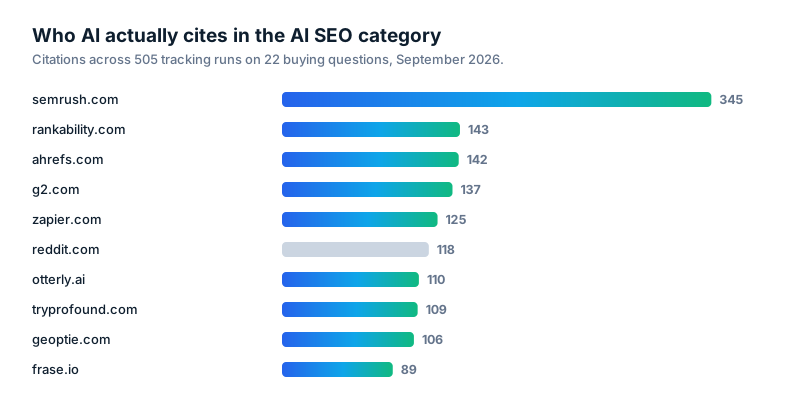
Sort by how reachable each is. A roundup written last month by a one-person newsletter is reachable. A Semrush category page is not. Start at the reachable end — in our own category we found Reddit was a top-ten source with 118 citations, and a forum thread is something a two-person company can be in this week.
Give them a reason that is not "please add us". A data point they do not have. A correction to something that is now wrong. A free tool their readers would use. The pitch that works is the one where their page gets better.
Expect a low hit rate and a high payoff. Two out of ten is a good result, and two pages in the cited set changes answers.
If neither of you is in the cited pages
The engine is naming brands it already knows rather than ones it just read. Your competitor is being named from memory, which means they have broader presence across the material the model was trained on: reviews, directories, sustained coverage.
This is slower and it is not hopeless. It is also not fixed by publishing, which is where most of the effort goes.
The work is review volume on the platforms that matter in your category, listings in the small specific directories, and one consistent description of what you do repeated everywhere. Months, and it compounds.
If you are in the cited pages but still not named
A different problem and a cheaper one. The page mentions you, the engine read it, and you did not make the answer.
Usually one of: you are mentioned in passing while the competitor has a paragraph, your description in that page is vague, or the page frames the competitor as the recommendation and you as an also-ran.
The fix is to get your entry in that page improved rather than to find new pages, which is a much easier ask of an editor than inclusion was.
What the first month should look like
Week 1. Check crawler access. Run the ten-question citation exercise. Build the domain tally. You now have a target list and you know which mode each question is in.
Week 2. Fix anything technical. Write to the three most reachable cited sources with a specific reason.
Week 3. Write the one page you are missing — the question you lose where nobody has written a good answer. Not ten pages.
Week 4. Re-ask the questions. Nothing will have moved yet. Record it anyway, because the baseline is what makes month three legible.
The thing to avoid
Deciding that because a competitor is winning, you need to do more of everything. The useful finding is almost always narrow: four pages, one question type, one technical blocker. Broad effort is how budgets get spent without anything moving.
Frequently asked questions
My competitor is smaller than us. How are they winning?
Because size is a weak signal here. In one market we measured, the typical cited site scored 25 out of 100 and a site scoring 8 was in the answer. Presence in the cited set beats authority.
Should I write about my competitor?
Comparison pages aimed at "[competitor] alternatives" are legitimate and they work. Just be accurate: engines and readers both punish comparison pages that misrepresent the other side.
How long before I catch up?
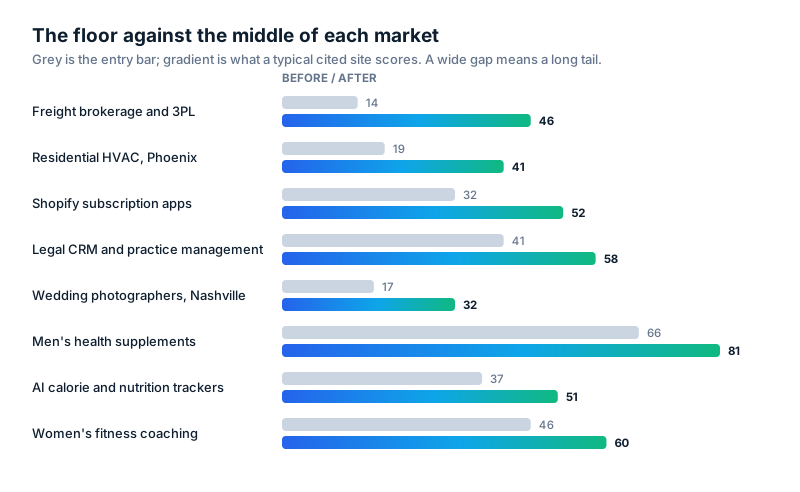
Depends on the market more than on the effort. We measured entry bars from 12 to 66 across fourteen markets — a quarter of work in one, a year in another.
Can I just pay to be in those roundups?
Sometimes, and it is usually disclosed as sponsorship, which affects how it is treated. The earned version is more durable and not much slower.